Municipalities owe Water Boards approximately R9 billion for bulk water (2018/19), an increase from R309 million over the previous year. The debt was R603 million in 2008/09.
This fact sheet unpacks the idea of visible policing in South Africa. In so doing, it highlights that the concept should be engaged with critically. It suggests that the SAPS sector policing philosophy, which is problem-oriented and data-led, should be the focus of the Visible Policing programme.
Sector policing is a decentralised, geographical, problem oriented and community-focused approach to policing. Simply put, it requires that every station precinct be divided into two or more sectors and that each sector be assigned a sector commander to coordinate and drive sector activities. In 2015 the South African Police Service (SAPS) published a Sector Policing Operational Guide, presenting a clear, in-depth overview of the sector police philosophy and how it should be implemented. This fact sheet reviews key tenets of sector policing as presented in the SAPS’ Sector Policing Operational Guidelines.
This factsheet maps the history and structure of the prosecution authority before and after 1994 showing that the independence of the prosecution authority oscillated between extreme points with reference to the relationship with the executive. The historical developments of the prosecution authority must be seen against the devolution and centralisation of prosecutorial power and its independence, or not, from political control and interference.
Artificial intelligence and big data are rapidly transforming the institutional relationship between the individual, the state, the market, the nature of work and the law across the board in fundamental, unpredictable ways. What impact the digital transformation will have on the role and function of “law” and “government” as basic social institutions is unforeseeable.
This discussion document deals with three key concepts associated with the National Prosecuting Authority (NPA) and its relation to the public, namely accountability, public interest and trust. It is suggested that for the NPA to be regarded as a legitimate institution it needs to enjoy trust and in order to enjoy such trust, it needs to be seen and perceived to act in the public interest in an accountable manner.
The Equality Court in Cape Town declares unfair discrimination in the allocation of police resources in the Western Cape.
Recent media reports showed again how police officials grossly misused their power and, against departmental prescripts, used a 'sjambok' to assault a man for apparently not wearing a mask. Such reports are not isolated and have a very direct impact on trust in the police and thus the legitimacy of the police. The core of the problem seems to be twofold (1) that SAPS managers are not enforcing the internal disciplinary code, and (2) the National Prosecuting Authority (NPA) very rarely prosecutes police officials, especially for human rights violations. We have updated ACJR Fact sheet 9 (originally published in February 2019) with statistics for the past two financial years and it appears that the situation has worsened. This does not bode well for general trust in the state and specifically in the police. There is little sense in tough talk about law enforcement when the police themselves are not being held accountable and increasingly regarded as hostile to the general public.
This fact sheet considers the performance of the National Prosecuting Authority since inception. The data suggests increases in investment have not brought commensurate returns.
How much do municipalities owe Eskom? What is being done about this financial crisis? What have provinces done?
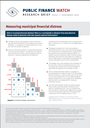
What is municipal financial distress? When is a municipality in distress? How does financial distress relate to financial crisis that requires external intervention?
The recent announcement by President Ramaphosa to call together a committee of experts to assist him to appoint a new National Director of Public Prosecutions (NDPP) is unprecedented, and an extremely important move in the right direction towards greater transparency and accountability at South Africa's National Prosecuting Authority. An earlier report by ACJR dealt in detail with the problems at the NPA and, amongst others, recommended that the appointment procedure of the NDPP be reformed. In this fact sheet the current procedure for the appointment and dismissal of the NDPP is set out and problems identified. This should inform debate and stimulate ideas on the reforms we would like to see.
This report investigates the legal frameworks of five African countries (Kenya Malawi, Mozambique, South Africa and Zambia) as they relate to the use of solitary confinement. The effect of long periods of solitary confinement have been shown to have severe impacts on a prisoner’s mental and physical well-being. The UN Human Rights Committee (UNHRC) has noted that the use of prolonged solitary confinement may amount to torture or to cruel, inhuman or degrading treatment or punishment, in breach of Article 7 of the International Covenant on Civil and Political Rights (ICCPR). In December 2015, the UN General Assembly adopted the revised United Nations Standard Minimum Rules for the Treatment of Prisoners, also known as the Nelson Mandela Rules (‘2015 UNSMR’). The 2015 UNSMR addresses a key shortcoming in the protection and treatment of people in places of detention, as it, for the first time, sets down norms and limitations on the use of solitary confinement. The report concludes that there are major areas of non-compliance in each of the countries and this requires urgent attention.
This report investigates the legal frameworks of five African countries (Kenya Malawi, Mozambique, South Africa and Zambia) as they relate to the use of solitary confinement. The effect of long periods of solitary confinement have been shown to have severe impacts on a prisoner’s mental and physical well-being. The UN Human Rights Committee (UNHRC) has noted that the use of prolonged solitary confinement may amount to torture or to cruel, inhuman or degrading treatment or punishment, in breach of Article 7 of the International Covenant on Civil and Political Rights (ICCPR). In December 2015, the UN General Assembly adopted the revised United Nations Standard Minimum Rules for the Treatment of Prisoners, also known as the Nelson Mandela Rules (‘2015 UNSMR’). The 2015 UNSMR addresses a key shortcoming in the protection and treatment of people in places of detention, as it, for the first time, sets down norms and limitations on the use of solitary confinement. The report concludes that there are major areas of non-compliance in each of the countries and this requires urgent attention
S v Frederick & S v Maxhongo, Judgment on Review 11 July 2018, Review 18531 and Review 18532. The Court asked that in cases where there is a long history of drug use and abuse, the prosecution should rather request a probation officer’s report to investigate the accused’s circumstances and the desirability or not of prosecution.
It is our submission that the issue to be addressed, namely the independence of IPID also relates to the relationship between IPID and the National Prosecuting Authority (NPA) and this submission focuses on that relationship as described in section 7(4-5) of the IPID Act. It will be submitted below that the effectiveness and impact of IPID is essentially at the mercy of the NPA.
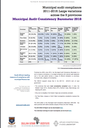
The Municipal Audit Consistency Barometer (MAC-B) uses data published by the AuditorGeneral to measure consistency in municipal compliance with national audit standards over a five-year period. One of six possible consistency ratings is awarded to every municipality based on the audit outcome which it consistently obtained in a given five-year period.
The Municipal Audit Consistency Barometer (MAC-B) uses data published by the AuditorGeneral to measure consistency in municipal compliance with national audit standards over a five-year period. One of six possible consistency ratings is awarded to every municipality based on the audit outcome which it consistently obtained in a given five-year period.
In 2013 the Western Cape legislature passed the Western Cape Community Safety Act (WCCSA) to improve monitoring of and oversight over the police. One creation of the WCCSA is the Western Cape Police Ombudsman, which became operational in 2015. This article reviews its history and context, as well as results from its first year. The Police Ombudsman, the only one in the country, must be seen as one of the results of efforts by the opposition-held province to carve out more powers in the narrowly defined constitutional space, and in so doing to exercise more effective oversight and monitoring of police performance, and improve police–community relations. The Ombudsman must also be seen against the backdrop of poor police–community relations in Cape Town and the subsequent establishment of a provincial commission of inquiry into the problem, a move that was opposed by the national government, contesting its constitutionality. Results from the Ombudsman’s first 18 months in operation are modest, but there are promising signs. Nonetheless, the office is small and it did not do itself any favours by not complying with its legally mandated reporting requirements. By Lukas Muntingh
In late May 2018 the Department of Correctional Services in South Africa hosted a roundtable to discuss its “Position paper: a revised parole system for South Africa”. Submissions were invited prior to the round table and ACJR made a submission critical of the position paper. Key problems identified, amongst others, are: the lack of quantitative data in the position paper making it difficult to formulate policy in the absence of fact; the large number of prisoners serving life imprisonment received scant attention; and that proposed separate legislation to govern parole may not solve problems in the current system.
Published by ACSL since 2014, the Municipal Audit Consistency Barometer is a tool to measure consistency in municipal compliance with national audit standards over a five year period (across a range of different indicators i.e provinces; municipal class, category of municipality).
Building a capable developmental state is a core priority in South Africa's National Development Plan, and a capable local sphere of government is a cornerstone of that goal. This year, 2018 marks the 20th Anniversary of the adoption of the White Paper on Local Government which gave effect to the new dispensation for democratic local government in our constitution.
There was a miscarriage of justice on several grounds, namely the denial of the accused’s right to a properly qualified interpreter, the refusal to allow his son to testify, and the negative bias of the presiding officer. The accused was not afforded a fair trial and his murder conviction therefore cannot stand.
The Child Justice Act since 2008 makes provision for the expungement of criminal records for offences committed by a child. Eligibility for expungement depends on the offence that was committed and certain offences cannot be expunged. This fact sheet describes the requirements and the process.
Since 2009 the Criminal Procedure Act provides for the expungement of certain criminal records depending on the sentence that was imposed. This fact sheet describes the requirements and process in relation to adults.
Published by ACSL since 2014, the Municipal Audit Consistency Barometer is a tool to measure consistency in municipal compliance with national audit standards over a five year period (across a range of different indicators i.e provinces; municipal class, category of municipality).

 Municipalities owe Water Boards R9-billion for bulk water