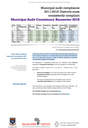
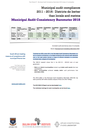
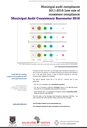
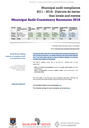
Published by ACSL since 2014, the Municipal Audit Consistency Barometer is a tool to measure consistency in municipal compliance with national audit standards over a five year period (across a range of different indicators i.e provinces; municipal class, category of municipality).
Published by ACSL since 2014, the Municipal Audit Consistency Barometer is a tool to measure consistency in municipal compliance with national audit standards over a five year period (across a range of different indicators i.e provinces; municipal class, category of municipality).
This article assesses developments in the prevention and eradication of torture in Mozambique. Despite several positive efforts and advances made, acts of torture and other cruel, inhuman and degrading treatment and punishment are still perpetrated by members of the security forces, especially police officials, often with impunity. The culture of impunity for such serious offences is a direct threat to human rights and the rule of law in the country and seriously compromises the country’s public integrity. Two issues are of deep concern and require more efforts by the state, namely: a) addressing impunity and ensuring prompt and impartial investigations of all allegations of torture and other ill-treatment, and b) protecting victims and providing the necessary restitution, rehabilitation and compensation. In conclusion we provide recommendations on how to improve the situation. These are: engaging in outreach and advocacy; improving and strengthening the national legislative framework; strengthening institutions; developing mechanisms for the reporting of torture: monitoring and evaluating existing reporting mechanisms; improving conditions of detention; establishing effective oversight over places of detention, and by maintaining records to improve transparency and availability of information. Report by Tina Lorizzo and Vanja Petrovic
The Capable Cities Index measures the capability of South Africa’s 271 major cities against specific indicators of capacity, compliance and performance that are under the operational control of a municipality and directly relevant to assessing how well local government is doing.
Este artigo avalia a evolução na prevenção e erradicação da tortura em Moçambique. Reportado por Tina Lorizzo e Vanja Petrovic
Published by ACSL since 2014, the Municipal Audit Consistency Barometer is a tool to measure consistency in municipal compliance with national audit standards over a five year period (across a range of different indicators i.e provinces; municipal class, category of municipality).
Published by ACSL since 2014, the Municipal Audit Consistency Barometer is a tool to measure consistency in municipal compliance with national audit standards over a five year period (across a range of different indicators i.e provinces; municipal class, category of municipality).
Em preparação da Submissão da Sociedade Civil ao Comitê de Direitos Humanos das Nações Unidas
The publication of this report is intended to draw attention to the absence of the State Report and place pressure on the government to comply with its reporting obligations and other substantive obligations as required by the ICCPR.
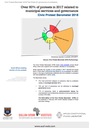
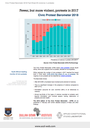
The Civic Protest Barometer (CPB) tracks civic protests across South Africa, which are a specific form of protest, directed at municipalities. While nationally the number of civic protests in 2017 reached the lowest level in three years (CPB 2018 Fact Sheet #1 (nr of protests), the pattern shown in the type of grievances underlying the civic protests is consistent with that established in earlier CPBs.
The Civic Protest Barometer (CPB) tracks civic protests across South Africa, which are a specific form of protest, directed at municipalities. While nationally the number of civic protests in 2017 reached the lowest level in three years (CPB 2018 Fact Sheet #1 (no. of protes
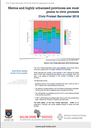
The Civic Protest Barometer tracks civic protests across South Africa, which are a specific form of protest, directed at municipalities. While nationally the number of civic protests in 2017 reached the lowest level in three years (CPB 2018 Fact Sheet #1 (no. of protests), there has been a fair degree of fluctuation in the number of protests in each province.
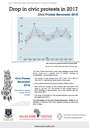
The Civic Protest Barometer tracks civic protests across South Africa, which are a specific form of protest, directed at municipalities.
In 2017, the Principles on the Decriminalisation of Petty Offences in Africa were adopted by the African Commission, becoming the latest development in a broader regional effort to articulate standards for acceptable human rights practices, specifically concerning matters of access to justice.These Principles seek to guide States on measures that can be taken to enhance human rights protections at the critical intersection of poverty and criminal justice.
Media Release:How do we know a municipality is a capable government? How do we measure the capacity of cities to contribute to building a capable state?
The Capable Cities Index (CCI) provides a methodology for measuring and ranking the capability of South Africa’s municipalities on the basis of their consistency in maintaining high levels of capacity, performance and compliance, with a focus on the 27 largest cities. Local government generally, and the major cities in particular, are crucial actors in the country’s development and in building a capable state in line with the National Development Plan (NDP).
The legal framework for spatial planning and land use management in South Africa is undergoing considerable change with a new national Spatial Planning and Land Use Management Act of 2013 (SPLUMA) and the adoption of municipal planning by-laws throughout the country. The Constitution permits provinces to also pass laws on the matter. Of the nine provinces, the Western Cape is the only province that has passed 'post-SPLUMA' provincial legislation. This report conducts an interim assessment of how some of the other provinces are approaching this issue. It analyses four provincial planning bills of Mpumalanga, North West, Free State and Limpopo.
The presumed link between the rule of law and development suggests that an operational justice system is key to development. The research sought to understand and quantify how the decision to detain an accused person affects his or her socio-economic situation. Data was collected in Kenya, Mozambique and Zambia. The findings suggest that the use of the coercive power of the state exercised through the deprivation of an individual’s liberty has serious socio-economic consequences. While detention pending trial is justifiable sometimes, we argue that it is over-used, frequently resulting in excessively long detention. The deprivation of liberty interferes with the ability of individuals to be agents of their own development, infringing on socio-economic rights of individuals and their dependents. States can justify such infringements only if their coercive power is used within the ambit of democratic and rights-respecting laws complying with human rights standards. By Lukas Muntingh and Jean Redpath
Report on the Symposium on Legal and Administrative Reforms to address Congestion in Correctional Facilities in Lusaka, Zambia between the 13th and 14th of September 2017, by the Programme for Legal Empowerment and Enhanced Justice Delivery (PLEED).
Challenges and Recommendations considering Legal and Administrative reforms
Gwen Dereymaeker gave the following presentation at a seminar organised by the Judicial Inspectorate for Correctional Services at Durban Correctional Centre on 7 September 2017. She first addresses the history of super-maximum prisons around the world, international criticism of supermax (being prolonged solitary confinement), and the supermax regime in the US and the UK. She then examines the South African regime, in particular that of Ebongweni: admission criteria, detention regime, challenges and questions whether the detention regime such as that practiced at Ebongweni is constitutional.
Presentation by Jean Redpath
Presentation by Lukas Muntingh
Apresentação de Gwen Dereymaeker
This presentation was made to Mozambican delegates during a seminar held on 7 June 2017 in Maputo, Mozambique.
Apresentação de Kristen Petersen

 Mun Audit Consistency Barometer 2018 FactSheet #9 - MACB-4 COGTA classes