

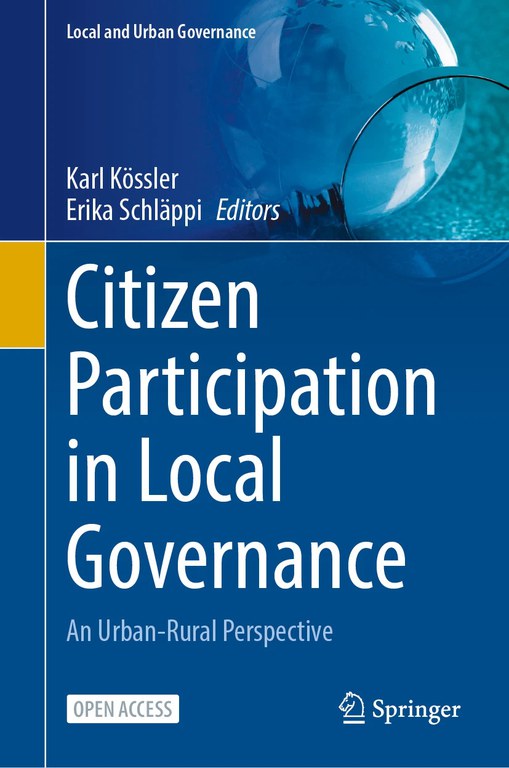
Book Chapter - 'Local Governance and Public Participation in South Africa: An Urban-Rural Perspective’
It argues that despite South Africa having an impressive range of legislative instruments detailing public participation mechanisms, the implementation of these mechanisms still leaves many behind in the practice of public participation. The chapter establishes that although public participation in the budget at the local government level is a constitutional imperative, this constitutional imperative is yet to be fully realized due to several institutional impediments, resulting in citizens viewing public participation as a mere rubber-stamping exercise. It finds that communities, instead of using invited spaces such as ward committees, are increasingly resorting to participation in invented spaces through engaging in protests, some of which turn violent. The chapter calls for addressing the issue of capacity and skills shortage of ward committees. It argues that the adoption of alternative methods, such as online meetings, to promote public participation has limited the space for disadvantaged communities and vulnerable groups, such as women, children, and those living in informal settlements, to participate in the budget formation process and worsened the digital divide between urban and rural communities.
The book ‘Citizen Participation in Local Governance: An Urban-Rural Perspective’, Karl Kössler and Erika Schläppi (eds) was published by Springer Cham.
This chapter can be accessed here. [Open Access]