The regulations for the 21-day lock-down starting on midnight 26 March 2020 are set out here in a simplified manner.
This booklet provides an overview of your right to food. (Published: October 2008)
This Info Sheet simplifies the COVID-19 lockdown regulations dated 15 April 2020.
On 25 March 2020, a group of civil society organisations working towards open and accountable legislatures, with a vested interest in promoting participatory democracy sent a letter which sought to engage Parliament prior to the period of lockdown. Despite making several recommendations to ready the institution and legislatures to continue their work into the state of disaster. The response from the legislatures was weak. Following a lack of response to the original letter, these organisations and others have today written again to the leadership of national and provincial legislatures appealing to them to ensure transparency, effective legislative oversight, and public engagement during the national state of disaster. The organisations have also again offered to support the legislatures as they grapple with some of these difficult, but critical questions.
Know Your Rights: Police and Military Action During Lockdown
On 30 March 2020, Minister of Justice and Correctional Services issued these Directions in the Schedule to address, prevent and combat the spread of COVID 19 in all courts, court precincts and justice service points in the Republic of South Africa.
Advice of the Subcommittee on Prevention of Torture to States Parties and National Preventive Mechanisms relating to the Coronavirus Pandemic
On 19 March 2020, the Chief Justice of South Africa issued this directive to prevent and curb the spread of COVID-19.
11 CSOs working towards open and accountable legislatures have sent an open letter to the Speakers of Parliament and the Provincial Legislatures, and to the Chairperson of the National Council of Provinces to encourage measures to support their functioning within South Africa’s Constitutional Democracy during this time of crisis and uncertainty. Even though elected representatives should not meet physically due to the lock-down and social distancing, they and the legislatures, continue to have an important democratic role to play, to exercise oversight over the executive and to ensure that the experiences of people most marginalised in our society are taken into account in planning and implementation during this period.
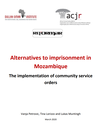
In December 2020 a revised Penal Code and new Criminal Procedure Code and Code on the Implementation of Penalties will enter into force in Mozambique. While substantial changes related to alternatives to imprisonment and specifically to community service will be introduced, this report assesses the implementation of community service orders (CSO) in Mozambique between 2015 and 2019. It examines its use by the courts and implementation by the Department for Corrections. The findings point to several implementation problems, such as its infrequent if not rare use by the courts as well as challenges in monitoring offenders by the Service for Alternatives to Imprisonment. A number of systemic problems were found, such as the lack of management, procedural guidelines, and training; understaffing, and a serious lack of material and financial resources necessary for the effective implementation of CSO. Regardless of a new legal framework, it is submitted that valuable lessons need to be taken from the period under review. Based on the findings, the report concludes with recommendations to address the shortcomings.
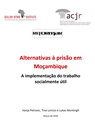
Em Dezembro de 2020 entrarão em vigor em Moçambique o Código Penal revisto, o novo Código de Processo Penal e o Código de Execução das Penas. Embora serão introduzidas mudanças substanciais relacionadas com as alternativas à prisão e especificamente ao trabalho socialmente útil (TSU), este relatório avalia a implementação do TSU em Moçambique entre 2015 e 2019. Examina o seu uso pelos tribunais e a implementação pelo Serviço Nacional Penitenciário (SERNAP). As conclusões apontam para vários problemas de implementação, como o seu uso pouco frequente pelos tribunais, bem como desafios na monitoria dos infractores pelo Serviço de Penas Alternativas à Pena de Prisão (SPAPP). Vários problemas sistémicos foram encontrados, como falta de gestão, directrizes processuais e formações e falta de recursos materiais e financeiros necessários para a implementação efectiva do TSU. Independentemente de uma nova estrutura legal, é evidente que será necessário retirar lições valiosas do período em análise. Nas conclusões, o relatório aponta algumas recomendações para abordar as deficiências. Reportado por Vanja Petrovic, Tina Lorizzo e Lukas Muntingh
Africa Criminal Justice Reform (ACJR) has produced research on the South African criminal justice system relating to prisons. This resource list contains summaries and links of work that we have produced in recent years on the topic of prisons.
Africa Criminal Justice Reform (ACJR) has produced research on the South African criminal justice system relating to the National Prosecuting Authority (NPA). This resource list contains summaries and links of work that we have produced in recent years on the topic of the NPA.
Africa Criminal Justice Reform (ACJR) has produced research on the South African criminal justice system relating to the police. This resource list contains summaries and links of work that we have produced in recent years on the topic of police.
This paper first examines the legal framework for the appointment and dismissal of board members to state-owned enterprises.
A proposed framework to assess suitability
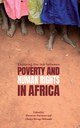
This book addresses poverty, one of the important issues confronting Africa, from a multi-disciplinary approach. With contributions from eminent scholars from diverse backgrounds, the book explores poverty from a human rights perspective. Its central message is that poverty is not necessarily a failure on the part of an individual, but rather caused by the actions or inactions of governments, which are often exacerbated by structural inequalities in many African societies. This in turn requires a more pragmatic approach grounded in respect for human rights. Exploring the link between poverty and human rights in Africa will be useful to researchers, policymakers, students, activists and others interested in addressing poverty.
The United Nations High-level Political Forum on Sustainable Development is an annual event where countries take stock of their progress towards the achievement of the Sustainable Development Goals. This report evaluates the status of the Voluntary National Reviews of selected countries in Africa and the extent to which they show progress in achieving SDG 16.3 on Access to Justice.
This factsheet deals with the power to arrest without a warrant in Mozambique. A 2013-decision by the Constitutional Council of Mozambique resulted in significant changes in law on who can arrest without a warrant, thus reducing the risk of arbitrary arrest. These changes and other developments bode well for reform in the criminal justice system. However, resource constraints place a substantive limitation on the Mozambican criminal justice system in general and specifically on complying with the 2013-decision of the Constitutional Council.
This fact sheet deals with arrest without a warrant in Zambia. It highlights the legal framework governing arrest without a warrant, the shortcomings in the legislation as well as some challenges with implementation as is evident from case law. The fact sheet recommends that the Zambian Criminal Procedure Code Act and the Police Act are reviewed and that the provisions on arrest without a warrant are amended to comply with international best practice on arrest in accordance to the obligations of the African Charter which seek to protect the right of life, dignity, equality and security of all people.
The Metro Open Budget Survey (Metro OBS) is modelled on the global Open Budget Survey (OBS) initiated by the International Budget Partnership in 2006. The OBS is an independent, comparative assessment of budget accountability: transparency, oversight, and public participation. The global OBS has been conducted six times and evaluates national government budget processes in 115 countries across six continents. The Metro OBS goes a level deeper by applying the OBS methodology to local government, and assesses five of the eight metropolitan municipalities (metros) in South Africa: City of Cape Town, City of Johannesburg, City of Ekurhuleni, eThekwini Municipality, and Nelson Mandela Bay Municipality. In 2018, IBP South Africa in partnership with the Dullah Omar Institute piloted the Metro OBS across the same five metros. The questionnaire used in this pilot was developed by adapting the 2017 international Open Budget Survey for the South African local government context. After using the 2018 pilot to test and refine the methodology, we rolled out the project in full from the beginning of 2019.
This fact sheet addresses alternative ways in which offenders of minor crimes can be dealt with at a court level using a more restorative justice approach. It proposes various forms of non-custodial sanctions that the court can impose; for example, community service, good behaviour orders as well as the completion of life skills programs.
This fact sheet addresses the role that prosecutors can play in dealing with offenders of minor crimes. It emphasizes the use of restorative justice approaches such as mediation, life skills programs and community service as a more appropriate way of dealing with minor offending rather than resorting to a criminal justice response.
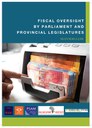
The Putting the People in ‘People’s Parliament’ Project (PPiPP) works to increase the participation of civil society organisations in legislatures, particularly at provincial level, including through increasing public knowledge on the role of legislatures and legislature processes. One important aspect of this is oversight of public finances. In line with that objective, this report constitutes a first attempt to understand public finance oversight processes, in theory and practice, at the provincial level. To do so, it first discusses national legislation and processes, then examines the corresponding situation at provincial level (in Gauteng, the Eastern Cape and Western Cape). The drafting of provincial money bills amendment legislation presents both an opportunity to reflect on and improve these processes, but is also a risk in as much as it could cement failings of the status quo.
This fact sheet addresses the role that law enforcement officials can play in dealing with offenders of minor crimes. It emphasizes the use of restorative justice approaches such as warnings and fines in combination with other programs as a more appropriate way of dealing with minor offending rather than resorting to a criminal justice response.
This report assesses the consequences of the 2013-decision of the Constitutional Council of Mozambique, which limits to judges the authority to order pre-trial detention for cases falling outside of flagrante delito (where the accused is caught in the act of committing the offence). Although the decision represents a progressive change in the jurisprudence of Mozambique’s highest court, judges, prosecutors and police encounter operational challenges in implementing the decision, in a country with a population of more than 28 million people. In 2017, there were 344 judges, 18 of which were Judges of Criminal Instruction, responsible for issuing warrants of arrest for cases outside of flagrante delito. Concerns were raised in relation to lack of financial and logistical resources for prosecutors, which are mandated to monitor the legality of police detention. As the criminal justice system is under-resourced, police officials have to wait for a judge to issue a warrant of arrest for cases falling outside of flagrante delito. Despite the decision, unlawful arrests continue to happen although there is anecdotal evidence that these have decreased. The 2013-decision has clarified who has the power to authorise arrest in these cases, but the situation is far from being resolved. Report by Tina Lorizzo and Vanja Petrovic

 ACJR INFO SHEET 2: The COVID-19 lock-down simplified