This presentation was made at a webinar on Sub-national governance and the plight of people working in public spaces on 14 November 2023
In this Policy Brief, we explore two issues, namely (1) what are the options for thresholds at municipal level? and (2) how to ensure that municipal service delivery continues when there is instability?
This oral submission was made at the Portfolio Committee on Justice and Correctional Services held public hearings on the National Prosecuting Authority (NPA) Amendment Bill on 25 October 2023
This oral submission was made at the Portfolio Committee on Justice and Correctional Services held public hearings on the Independent Police Investigative Directorate (IPID) Amendment Bill [B21-2023] on 25 October 2023
Sub-national law enforcement (when properly organised) supplements the work of national police at a local level by strengthening community-police relations and allowing for the swift response to emergency situations. However, this is only possible if each local law enforcement agency has, amongst others, formal standardised training, independent budgets, and existing effective mechanisms for public complaints, oversight and monitoring. This Fact Sheet provides a situational analysis of sub-national law enforcement in two west African countries, one east African and one southern African country; namely, Ghana, Kenya, Nigeria, and Zambia and highlights some of the challenges present in each context, particularly with regards to enforcement targeted at those working within public spaces.
Dullah Omar Institute submission to Special Rapporteur on the right to adequate housing and the Special Rapporteur on extreme poverty and human rights - Call for Input: Decriminalisation of homelessness and extreme poverty
This presentation was made at a webinar on "Sub-national Governance, Law Enforcement and Oversight in Five African countries: Ghana, Kenya, Nigeria, South Africa and Zambia" on 30 August 2023
This presentation was made at a webinar on "Sub-national Governance, Law Enforcement and Oversight in Five African countries: Ghana, Kenya, Nigeria, South Africa and Zambia" on 30 August 2023
This presentation was made at a webinar on "Sub-national Governance, Law Enforcement and Oversight in Five African countries: Ghana, Kenya, Nigeria, South Africa and Zambia" on 30 August 2023
This presentation was made at a webinar on "What is crime data telling us?" on 15 August 2023
Public space forms the setting for a number of activities, including the setting for community life and livelihoods of the urban poor, such as street vendors or waste-pickers. There is growing evidence pointing to the problematic way in which public space is governed. In many developing countries, laws and policies, particularly at a local government level, tend to restrict the ability of people to earn a livelihood or perform life-sustaining activities in public spaces. Contravention of local ordinances or by-laws is frequently treated as a criminal offence, compromising informal dwellers and workers’ livelihoods, denying due process protections and often violating their human rights. In this factsheet, we contextualise how laws and policies result in the criminalisation of the poor and consider principles that are fundamental to good policy-making.
This submission was made to the National Department of Health, South Africa on 20 July 2023
The Detention Justice Forum, to which ACJR is a Coordinating member, made a written submission to the Portfolio Committee on Justice and Correctional Services on the Correctional Services Amendment Bill B14-2023 on 14 July 2023.
This presentation was made at a webinar on The Right to Public Spaces and Informal Work: Key considerations for Law & Policy-Making, 28 June 2023
This presentation was made at a webinar on The Right to Public Spaces and Informal Work: Key considerations for Law & Policy-Making, 28 June 2023
This presentation was made at a webinar on The Right to Public Spaces and Informal Work: Key considerations for Law & Policy-Making, 28 June 2023
Africa Criminal Justice Reform submission: The Judicial Matters Amendment Bill [B7-2023] in South Africa.
This report presents the findings of a study conducted by the Dullah Omar Institute (DOI) in partnership with the International Budget Partnership South Africa (IBP-SA). The study examined the state of transparency in local government procurement, in particular the reasons why municipalities do not publish key procurement information on their websites and National Treasury’s eTender Portal timeously and consistently. Procurement information in this context includes tender notices, tender specifications, and tender awards.
After signing the Optional Protocol to UNCAT (OPCAT) in 2006 and ratifying it in March 2019, South Africa designated a National Preventive Mechanism (NPM), with the SA Human Rights Commission (SAHRC) being the coordinating structure. Since ratification in March 2019, it appears that to date, the NPM has not been fully functional and institutional arrangements for visiting places of detention under the banner of the NPM remain unclear. There is also uncertainty as to how the constituent parts of the NPM will fulfil the responsibilities under OPCAT. In view of the above, the members of the Detention Justice Forum (DJF) agreed to assess the operational functionality of the NPM in the respective sectors of the DJF member organisations. This also provided an opportunity to identify issues for clarification on the NPM’s mandate and its relations with other components as well as government departments responsible for places where people are or may be deprived of their liberty. This report provides the findings of the assessment performed amongst members of the Detention Justice Forum (DJF) based off a questionnaire that was developed. This report was prepared by K Petersen & J Mangwanda, December 2022
ACJR’s submission is in response to the call from the UN Special Rapporteur on extrajudicial, summary, or arbitrary executions (UNSR) to collect information on practices for the investigation, documentation, and prevention of deaths in custody in the criminal justice context. The UNSR’s report aims to raise awareness about deaths in custody globally and to contribute to the protection of the right to life of those deprived of liberty, including practical recommendations and best practices on the effective investigation, documentation, and prevention of custodial deaths. This submission focuses on South Africa and pays particular attention to custody situations under the control of the police and the Department of Correctional Services (DCS). The submission would inform the UNSR report to be presented to the Human Rights Council in June 2023.
This submission was made to the Subcommitee for the Prevention of Torture and Other and other Cruel, Inhuman or Degrading Treatment or Punishment (SPT) on 13 February 2023
This presentation was made at a webinar on Sub-national Government and the Criminalisation of Poverty & Status: Defining the problem, 4 April 2023
This presentation was made at a webinar on Sub-national Government and the Criminalisation of Poverty & Status: Defining the problem, 4 April 2023
This presentation was made at a webinar on Sub-national Government and the Criminalisation of Poverty & Status: Defining the problem, 4 April 2023
It was reported from Guinea Bissau on 20 March 2023 that a new law will prohibit Islamic leaders using children for begging. The President of Guinea-Bissau, Umaro Sissoco Embaló ordered that from Monday, 27 March 2023, child mendicity will be prohibited and that fathers or Koranic teachers of any child caught begging in the streets of the country would be arrested. The President considers shameful to send children in the streets of Bissau and neighbouring countries to raise support for their Koranic teachers. The regular practice perpetrated by some Islamic leaders have created an alarming phenomenon nationally and in the region. As members of the global Campaign to Decriminalise Poverty and Status advocating for the repeal of laws that target people based on poverty, status or for their activism, we are, however, concerned for those children who beg on the streets not sent by their religious teachers, but forced by their economic and social situation. For those children, mendicity may be the only means of subsistence because the state may not have adequate social, economic and other relief measures in place to combat their poverty. The full joint statement can be found here.
This report provides an analysis of a survey of Magistrates' perceptions of prosecutors conducted in 2022. Prepared by Michael O’Donovan with Jean Redpath
This presentation was made at a webinar on Magistrates’ Perceptions of Prosecutors: Survey Analysis, 22 February 2023
Cape Declaration on Decriminalising Poverty and Status, adopted by consensus by the participants of the convening of the Campaign to Decriminalise Poverty and Status held in Stellenbosch, South Africa between 27 and 29 September 2022
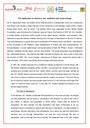
This report summaries what emerged during the lecture on 'The application of ubuntu in law, mediation and social change.'
This presentation was made at a webinar on The NPA that we want, 17 October 2022.

 Presentation: Sub-national governance and the plight of people working in public spaces | by Janelle Mangwanda
![[Report] An assessment of the National Preventive Mechanism (NPM) in South Africa](https://dullahomarinstitute.org.za/acjr/acjr-publications/original-npm-report-2022.pdf/@@images/b268f992-baad-48f1-b946-4c399f9eec83.png "[Report] An assessment of the National Preventive Mechanism (NPM) in South Africa")