Much of the media attention given to the National Prosecuting Authority (NPA) is centered on high-level corruption investigations, especially linked to the Zondo Commission’s findings and recommendations. While this is important, it should also be asked what happens at ground-level in our courts where ordinary cases are heard on a daily basis. The question can indeed be asked: What are our expectations of the NPA when having to engage with the criminal justice system as a victim, witness or even an accused? Do we know what we want from the NPA in real and practical terms? In June and July 2022 ACJR commissioned a series of consultation workshops with stakeholders to discuss these questions and develop descriptions of “the NPA that we want”. The consultations yielded valuable observations and insights, demonstrating on the one hand that people generally have a deep understanding of the challenges facing the NPA and, on the other hand, clear understandings of what they expect of the NPA, especially as these relate to the four core values of professionalism, independence, accountability, and credibility.
In December 2020, the Constitutional Court confirmed the order of constitutional invalidity made by the Western Cape High Court in Sonke Gender Justice NPC v President of the Republic of South Africa and Others regarding certain provisions of the Correctional Services Act dealing with the independence of the Judicial Inspectorate for Correctional Services. The Court gave Parliament two years to rectify these issues; an approach that has been used previously by the Court. The two-year period will lapse on 3 December 2022, which is less than three months into the future. The Detention Justice Forum calls on all relevant state actors to make public the plan for meaningful public participation on the draft Bill and all steps necessary to ensure that the Sonke decision is substantively given effect to.
COVID-19 restrictions and the impact on criminal justice & human rights, Malawi
COVID-19 restrictions and the impact on criminal justice and human rights, Malawi
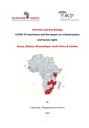
This report makes a number of overview observations dealing with broader issues of governance, human rights, the socio-economic impact of the COVID-19 pandemic and the criminal justice system. A central lesson to be taken from these findings is the need for continued vigilance in seeking a balancing of rights and the importance of evidence-based policy-making, especially where there is the potential that those already socio-economically vulnerable may be pushed deeper into poverty. Report by L Muntingh, J Mangwanda & K Petersen
Report by J Mangwanda & K Petersen (2022)
Report by K Petersen and J Mangwanda (2022)
Report by T Lorizzo and V Petrovic (2022)
Report by K Petersen, J Mangwanda, L Muntingh and J Redpath (2022)
Report by J Mangwanda and K Petersen (2022)
COVID-19 restrictions and the impact on criminal justice and human rights (Kenya, Malawi, Mozambique, South Africa & Zambia)
Overview and key findings: COVID-19 restrictions and the impact on criminal justice and human rights (Kenya, Malawi, Mozambique, South Africa & Zambia)
COVID-19 restrictions and the impact on criminal justice & human rights (Kenya, Malawi, Mozambique, South Africa & Zambia)
This presentation was made at the Webinar on the Prosecution of corruption in municipalities with Advocate Barry Madolo (NPA) on 14 June 2022
Memorandum from the Judiciary on Corona Virus (Covid-19) – Precautionary Measures
Memorandum from the Judiciary on Corona Virus (Covid-19) – Precautionary Measures
The Womxn and Democracy Initiative and the Parliamentary Monitoring Group undertook monitoring of the information that was available regarding National Parliament committee meetings from April 2020 through to 31 March 2021 during the first year of the National State of Disaster.The purpose of this research was to assess the extent to which parliamentary committees have complied with their obligation to be open and transparent, and to facilitate public access under the conditions of the pandemic.
This submission is in relation to draft regulations published in Gazette 46048 of 15 March 2022
ACJR statement to the African Commission under the item Human Rights Situation in Africa addresses the concerns around African States' handling of the COVID-19 pandemic and the fact that law enforcement officials implicated in rights violations against citizens in the context of COVID-19 have not been held accountable for their actions.
Transparency, Accountability, Independence Independence is an essential feature of the proper exercise of prosecutorial discretion. Independence requires that justice be dispensed without ‘fear, favour or prejudice.’ Independence cannot exist alone: it must co-exist with accountability. Transparency is required to ensure accountability: if no-one is seen to be held accountable for the exercise of prosecutorial discretion, how can the public ever have any assurance that decisions are not tainted or improper?
This paper problematises the strategy environment of the NPA and raises questions about how strategy is developed, the priorities set and how performance is measured. The overall impression is of a situation where strategy priorities and objectives emanate from different sources, but that the most measurable is what drives performance at operational level and not necessarily the most needed or most important to make the country safer and build trust in the state. The NPA finds itself in a complex strategy environment: various strategy documents not only have different time frames but also emanate from different sources and fundamentally different purposes. Finding harmony and synchronicity in this strategy environment must be difficult for the NPA leadership.
The capacity, knowledge, skills and experience of an organisation's workforce will determine largely the extent to which it is able to fulfil its mandate. The aim in this issue paper is to problematise this particular issue in a succinct manner with the view to build consensus on understanding the problem properly in order to develop effective short to medium term responses. Transparency and accuracy in reporting on the NPA's human resources is a notable problem. Three broad issues are explored, being vacancies, job satisfaction and skills requirements of prosecutors. The problems are not new and there is ample guidance from the literature and practice to address the issues.
The question of the effectiveness and efficiency of the NPA is key to the proper functioning of South Africa’s democracy. This is because the NPA is the sole custodian of criminal accountability. Properly measuring effectiveness and efficiency is key to ensuring that the NPA does in fact functioning correctly. The evidence suggests that the way in which effectiveness has been measured has not only failed to do this, but has created perverse incentives which have undermined effectiveness. Effectiveness and efficiency are separate enquires and should be interrogated separately.
The National Prosecuting Authority (NPA) tends to follow a highly secretive and confidential approach to all prosecutions, including those in relation to high-profile corruption. The problem with this approach is that it fails to take into account the reasons for confidentiality and secrecy, and whether or not those reasons still pertain in high-profile corruption cases. The approach also fails to appreciate the risks posed by an unnecessarily secretive approach in these kinds of matters. This Issue Paper will consider the special case of high profile corruption and comment on the nature and extent of transparency necessary in such cases.
Public accountability is crucial to demonstrating and achieving independence. Accountability through public transparency can achieve the level of prosecutorial independence and accountability required to ensure that the public has confidence in the decisions being made, thus ensuring the trust of public. Various kinds of accountability apply to the NPA: internal accountability, accountability to Parliament, and public accountability. This Issue Paper argues that heightened public accountability, through clarity and transparency of policies and processes, are required to ensure an objective, independent, Constitutional prosecution service, which enjoys public trust.
How effective is the NPA? Is measurement part of the problem?

 Summary report on consultations with civil society stakeholders: “The NPA that we want”