This submission to the South African parliamentary Portfolio Committee on Justice and Correctional Services on the 2008/9 Department of Correctional Services Annual Report addresses the issues of safe custody, challenges faced by the pre-trial detention population, staff management and social reintegration.
This report renews Amnesty International’s call on the Mozambican authorities to ensure that there are thorough, prompt and impartial investigations into all cases of use of force by the police resulting in death; that the officers responsible for unlawful killings are brought to justice in fair trials; and that families of those killed receive adequate reparation. It highlights the obstacles to accessing justice for families of victims of unlawful killings by the police and calls on the authorities to remove these obstacles.
This month's newspaper articles focus on Prisoner Exchange and Transfer; Condition of Detention; Sentencing and Parole; Government and Corruption as well as prison related news from other parts of Africa.
by Andy Barclay & Colin Allen, International Centre for Prison Studies, Kings College, London. Paper presented at The Middle East Centre at St. Antony’s College, Oxford, 25-27 September 2009
"The Applicants’ affidavits show that he is a convicted prisoner serving a 12 year prison term effective 2006. He was first at Chichiri Prison but presently he is at Domasi Prison. He avers that ever since his imprisonment, he and his fellow prisoners have been subjected to torture and cruel, inhuman and degrading treatment or punishment which is an infringement of his rights which he believes to be non-derogable as per Section 44 of the Constitution."
Prepared by the Programme National de Lutte contre la Tuberculose from Côte d’Ivoire with the support of Bernard Laouze, Alexandra Sanchez and Marie Catherine Receveur of ESTHER/Stop TB.
This submission was made to South Africa's Parliamentary Portfolio Committee on Correctional Services, in response to DCS tabling its 2009/10 Annual Report. The submission discusses internal and external accountability, inmate labour, parole and social reintegration, human resources management, and services to offenders.
This month's newspaper articles focus on the following topics: Governance and Corruption; Parole and Sentencing; Overcrowding; Safe Custody; Escapes; and Prison-related information in other African Countries.
Media Reports for August included within the following topics are: Conditions of Detention; Governance and Corruption; Labour Relations; Sentencing, Pardons and Parole; Escapes, Deaths and Security; and reports on prison reform in other parts of Africa.
Loi n°55/AN/09/6ème L relative à la violence contre les femmes notamment les Mutilations Génitales Féminines
This month's newspaper articles focus on the following topics: sentencing and parole; overcrowding; prison conditions; governance and corruption; and articles about prison related information in other African countries.
"Human Rights Watch has documented real or perceived government opponents’ experiences of abuse ranging from arbitrary arrest and detention without trial to torture, harassment, and extrajudicial killing. As documented below, Equatoguinean security forces have also kidnapped opposition politicians in exile in order for them to stand trial in Equatorial Guinea."
elaboração da presente proposta de Lei de Bases da Organização Judiciária é o resultado de um longo trabalho de investigação e de reflexão, com a participação de uma pluralidade de actores do sistema de justiça e da comunidade na elaboração do diagnóstico dos problemas e das propostas de solução
The submission deals with the following: the size of the budget; the size of the prison population; Meeting the minimum standards of humane detention; Performance and operations indicators; Engaging prisoners in programmes and employment; Development of sentence plans; Preparing for release and post-release support; and the handover report.
This issue focuses on the Relationship between Assault and Overcrowding in South African Prisons.
This newsletter focuses on the List of Issues recently released by the UN Committee against Torture in view of South Africa's next periodic report that is due 31 December 2009.
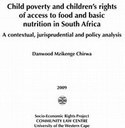
Research Report number 7. This research report is written by Prof Danwood Mzikenge Chirwa. Millions of children in South Africa bear the yoke of extreme forms of poverty and its associated evils, such as malnourishment, stunted growth, nutritional-deficiency diseases and illiteracy. The depreciation of the South African rand towards the end of 2008 and the current global financial crisis have only served to entrench child poverty by pushing poor households into deeper levels of deprivation and relegating those who were previously financially stable to the status of the poor.
Media articles on prison related issues include the following: prisoners' rights, South Africans in foreign prisons, medical parole, sentencing, parole and pardons, unsentenced prisoners.
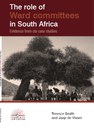
Ward committees are posited as the focal point for community participation in municipalities. There are many questions, however, about how effective they are; whether they are useful conduits for community involvement in governance; whether, as ‘created spaces’ for public participation, they are inherently capable of playing that role; and whether they create opportunities for real power-sharing between municipalities and citizens. This research report offers contains in-depth qualitative studies of six ward committees. It provides insight into how ward committees are functioning and the key reasons behind the some of the problems many appear to have. It also provides valuable lessons for strengthening the role of ward committees.
This publication is intended to provide the reader with a simple overview of the contents of the Child Justice Act 75 of 2008 (the Act). It attempts to reduce the ‘legalise’ of the Act; remove constant cross-references to other sections; and bring themes together in a logical and user-friendly manner.
African Human Security Initiative, Monograph 160, May 2009
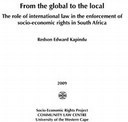
Socio-Economic Rights Project Research Series 6, 2009. This research paper by Redson Edward Kapindu explores the vital role of international human rights law and jurisprudence, including the UN and African human rights systems and policy frameworks, in advancing socio-economic rights at the domestic level in South Africa. The paper starts by providing a general overview of the international (including African regional) human rights system and their relevance. The paper proceeds to explore the question of the applicability of international human rights law under the South African Constitution. In this regard, the paper provides an incisive discussion of the domestic application of international socio-economic rights obligations in South Africa, paying special regard to the significance of General Comment 9 of the CESCR and the issue of minimum core obligations. The paper concludes with an exposition of some of the challenges in the application of international law in advancing socio-economic rights in South Africa and provides some recommendations.


 Parliamentary Submission on the 2008/9 DCS Annual Report