
 1. Department of Social Development
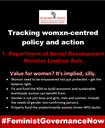 1. Department of Social Development
2. Department of Women, Youth and Persons With Disabilities
1. Department of Social Development
2. Department of Women, Youth and Persons With Disabilities
 The Regulation of Public Enterprises in Ethiopia: Lessons for South Africa

The paper shows that, in Ethiopia, SOE operations are not immune from undue political interference.
Isishwankathelo seEngcebiso ezenzelwe umZantsi Afrika ezivela kwiKomiti yeZizwe eziManyeneyo yaMalungelo eZoqoqosho, eZentlalo neNkcubeko
UMnqophiso waMazwe ngaMazwe waMalungelo eZoqoqosho, eZentlalo kunye neNkcubeko (uMnqophiso) sisivumelwano samalungelo abantu samazwe ngamazwe sombutho waMazwe aManyeneyo (i-UN). Samkelwa ngomhla we-10 kuDisemba 1966 saza saqalisa ukusebenza ngomhla wesi-3 kuJanyuwari 1976. Lo Mnqophiso ukhusela intlaninge yamalungelo ezoqoqosho, ezentlalo nenkcubeko (amalungelo ezentlalo nawoqoqosho). Uhlangene noMnqophiso waMazwe ngaMazwe waMalungelo eZoluntu neZopolitiko (International Covenant on Civil and Political Rights - ICCPR), nowamkelwa ngaxeshanye, lo Mnqophiso usisiseko somthetho wamalungelo abantu wamazwe ngamazwe kwaye watyikitywa ngamazwe ali-169 ehlabathini liphela. Onke amazwe aseAfika, ngaphandle kweBotswana, iMozambique neSouth Sudan, atyikitya kwaye ke ngoko abophelelekile kulo Mnqophiso. UMzantsi Afrika wawutyikitya lo Mnqophiso ngomhla we-12 kuJanyuwari 2015.
Opsomming van Aanbevelings vir Suid-Afrika deur die Verenigde Nasies se Komitee oor Ekonomiese, Maatskaplike en Kulturele Regte
Die Internasionale Verbond oor Ekonomiese, Maatskaplike en Kulturele Regte (die Verbond) is ’n internasionale menseregteverdrag van die Verenigde Nasies (VN). Dit is op 10 Desember 1966 aanvaar en het op 3 Januarie 1976 van krag geword. Die Verbond beskerm ’n wye reeks ekonomiese, maatskaplike en kulturele regte (sosioekonomiese regte). Saam met die Internasionale Verbond oor Burgerlike en Politieke Regte (ICCPR), wat terselfdertyd aanvaar is, vorm die Verbond die hoeksteen van internasionale wetgewing oor menseregte. Dit is reeds deur 169 lande regoor die wêreld onderskryf en bekragtig. Alle Afrikalande, met die uitsondering van Botswana, Mosambiek en Suid-Soedan, het die Verbond bekragtig en is dus tot die handhawing daarvan verbind. Suid-Afrika het die Verbond op 12 Januarie 2015 bekragtig.
 Summary of Recommendations for South Africa from the United Nations Committee on Economic, Social and Cultural Rights
The International Covenant on Economic, Social and Cultural Rights (Covenant) is an international human rights treaty of the United Nations (UN). It was adopted on 10 December 1966 and came into force on 3 January 1976. The Covenant protects a wide range of economic, social and cultural rights (socio-economic rights). Together with the International Covenant on Civil and Political Rights (ICCPR), which was adopted at the same time, the Covenant forms the cornerstone of international human rights law and has been ratified by 169 countries around the world. All African countries, except Botswana, Mozambique and South Sudan, have ratified and are therefore bound by the Covenant. South Africa ratified the Covenant on 12 January 2015.
Legal Framework for SOE Boards: Eskom, Prasa and the SABC
This research report examines the regulatory framework governing board and executive appointments, dismissals and duties at ESKOM, PRASA and the SABC.
ACJR Submission to the Zondo Commission on the National Prosecuting Authority
"The current legislation, structure, policies and operations of the NPA result in the outcome that few persons are convicted of serious crimes, and that state officials, in particular, are more likely to escape prosecution. That is, state officials experience impunity for rights violations and for offences related to state capture."
Report back: International Conference on 2019 National and Provincial Elections
On 25 April 2019, the SARChI Chair, Dullah Omar Institute, and Department of Political Studies (UWC) held an International Conference focusing on National and Provincial Elections of 8 May 2019. The key questions at the conference were: Populism, provincialism, womxn, and election credibility The national and provincial elections of 8 May 2019 are regarded by many as the most important since the first democratic elections of 1994. Four key questions were addressed by four panels of experts, with some placed in an international comparative perspective. This event was part of a series of roundtables on human rights and democracy.
Fact Sheet 18: A guide to reading government annual reports
Government departments use annual reports to report on their performance against set objectives stated in their Annual Performance Plans (APP) and the Medium-Term Expenditure Frameworks (MTEF). Annual reports also serve the function of promoting accountability and transparency which should improve trust and confidence in government’s ability to deliver on services. It is especially for civil society organisations that annual reports can be invaluable when holding government accountable. There are, however, certain challenges that readers of annual reports encounter, most notably the fact that annual reports are generally long and complex. Furthermore, the issue of erroneous and intermittent reporting is cause of concern when it comes to analysing an annual report. This fact sheet serves as a guide on how to read government department annual reports and highlights key issues to consider.
Liberty not the only loss - The Socio-Economic Impact of Remand Detention in the Western Cape
The evidence in this study suggests that the criminal procedural system metes out a disproportionate ‘punishment’ in the form of infringement of the socio-economic rights of the families of detainees, regardless of guilt or innocence.The study recommends a number of interventions to seek to ensure that remand detention is used only for short durations or when absolutely necessary, thereby minimising socio-economic harms. Report by Jean Redpath
Fact Sheet 17: The right of prisoners to vote in Africa (Updated)
This fact-sheet provides a brief update on the right of prisoners to vote in Africa. There have been substantive advances and breakthroughs in the promotion of this right as courts in Ghana, Kenya, Nigeria, South Africa, Zambia and most recently in Uganda have granted prisoners the right to vote. In Mozambique, the Ombudsman has made a recommendation that measures be put in place to allow prisoners to vote in future elections. The enfranchisement of prisoners is a positive step in the promotion of their basic human rights, it is therefore important that countries on the continent that are still lagging behind consider the above examples and follow suit.
Rights Behind Bars: A Study of Prison Conditions in Zimbabwe
The primary objectives of this study were to assess the compliance of selected prisons with international and domestic standards on conditions of detention; to consolidate the findings from the prison monitoring project conducted by the Zimbabwe Human Rights NGO Forum (the Forum) and its membership; to make recommendations for reforms and propose key priority areas. This was from 2018 was publicized in May 2019.
Feminist Analysis of ANC, EFF and DA Manifestos - In Brief
How do top three parties deal with womxn? Not just on GBV and representation - On all areas of life? GBV is an issue of the day – what about land and housing and jobs?
Woman Forward Party Analysis 2019
Women Forward Party Key Points 2019
Feminist view of political parties Project Overview
EFF Manifesto Key Points 2019
EFF Party Analysis 2019
DA Party Keypoints 2019
DA Party Analysis 2019
ANC Party Analysis 2019
ANC Key points 2019
ESR Review, Volume 21 No. 4, 2018
 ESR Review, Volume 20 No. 3, 2018
 Parliament Watch Scorecard
Parliament Watch Submission
Legal Framework for SOE Boards
Parliament Watch Scorecard
Parliament Watch Submission
Legal Framework for SOE Boards

This research report is examining the law on appointing SOE Boards. This is informed by a need for greater transparency and quality in these appointments. The research shows that the legal and policy framework for these appointments needs urgent reform.
Fact Sheet 16: Arrest without a warrant: Guidelines against arbitrary and unlawful arrests
This fact sheet deals with the process of arrest without a warrant and aims to provide guidance on how police officers should test and use their discretion when contemplating an arrest without a warrant. The fact sheet is not country specific and describes the overall and generally accepted requirements for arrest without a warrant.
Fact Sheet 15: Democratic Policing: A Conceptual Framework
This fact sheet discusses democratic policing as meaning (1) the police’s abidance to the rule of law, (2) accountability of the police, and (3) procedural fairness by the police in service of the public. Nine dimensions required for democratic policing are identified with the intended final outcome being public trust in the police which results in the police having legitimacy. The conceptual framework presented is not merely meant to describe democratic policing but rather to guide strategic planning in police organizations including the South African Police Service (SAPS). This relates in particular to the strategic objectives formulated in Medium Term Strategic Framework and annual performance plans with particular reference to the input variables and the outputs they need to deliver.