The Khayelitsha Commission revealed that areas that are predominantly populated by people who are poor and black are systematically allocated only a small fraction of the average per capita allocation of police personnel in the Western Cape. These areas also suffer among the highest rates of murder and serious violent crime in the province. The allocation of human resources to policing impinges on various constitutional rights. Given the inequity and irrationality apparent in the allocation of police personnel, the Khayelitsha Commission recommended that this method be urgently revised. This article reviews the evidence heard on the allocations and the method currently used to allocate police personnel, suggests an alternative method, and calls on the government to heed the recommendation of the Khayelitsha Commission that the state urgently revise its method of allocation of policing resources. By Jean Redpath and Fairouz Nagia-Luddy
This is a judgment of the Eastern Cape Local Division at Port Elizabeth of the High Court of South Africa, and relates to a claim for damages arising from allegations of torture occurring at St. Albans Prison.
This fact sheet explains sentencing under section 276(1)(i) of the Criminal Procedure Act, with particular reference to the case of Oscar Pistorius.
The Compliance Index (ComI) is one of three indices that together comprise the Capable Cities Index (CCI). The Capacity Index was published in early 2015 and the Performance Index will be published in due course.
This submission deals with South Africa’s performance in relation to, and compliance with, international standards with reference to offender management, offender rehabilitation and independent monitoring, as was requested by the Portfolio Committee on Justice and Correctional Services (the Portfolio Committee).
The Community Law Centre’s Children’s Rights Project is calling for a consultant to produce a concept note for the commemoration of the Day of the African Child (DAC) 2016 on the theme, “Conflict and Crisis in Africa: Protecting all children’s rights”.
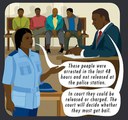
This guide is for anyone who needs a quick reference to the laws around arrest and detention in Malawi. This may include police, court clerks, prosecutors, magistrates, paralegals and detainees. First there is an orientation to the criminal justice system and a diagram and summary of what happens in Malawi around arrest and detention, page 1. The main part of the book focuses on what the Criminal Procedure and Evidence Code says. It starts with when and how arrest can happen and possibilities for release at the police station, page 4. This is followed by a section on how things happen in court and how people can be released by the court, page 12. There are special sections on the arrest and release of children, pages 7 and 11. There is also a list of children’s offences that are considered serious, see page 34, and there is a section on the maximum times allowed for the commencement and duration of trial, page 16. The rights of every person in Malawi, as well as the specific rights of those who have been arrested and detained are described, pages 18 - 21. The meanings of legal words can be found in the glossary near the back, page 22. At the very back is a long list of all the offences for which someone can be arrested in Malawi. These offences are divided into those that need a warrant for arrest, and those that do not, page 26
This fact sheet considers South African and International Law on the issue of solitary confinement and segregation.
This project investigated how individuals with psychosocial and intellectual disabilities are dealt with by the criminal justice system in Zambia, and developed recommendations for improving policy and practice. The project was undertaken by a consortium of non-governmental organisations (NGOs) comprising the Paralegal Alliance Network (PAN), Mental Health Users Network Zambia (MHUNZA), the Prisons Care and Counselling Association (PRISCCA), the Zambia Federation of Disability Organisations (ZAFOD), the Legal Resources Foundation (LRF) and the UK-based Prison Reform Trust. The work was funded by the Open Society Initiative for Southern Africa (OSISA) and the Human Rights Initiative at the Open Society Foundations, and was overseen by a steering committee chaired by the Ministry of Home Affairs.
This is the presentation made by Jean Redpath on an introduction to indicators at a seminar held in Cape Town in May 2015.
This is the presentation made by Jean Redpath on an introduction to indicators at a seminar held in Cape Town on 20 May 2015
This is the first issue of the ESR Review in 2015. For the realisation of socio-economic rights, 2015 began on a high note with South Africa’s long-awaited ratification of the International Covenant on Economic, Social and Cultural Rights (ICESCR). This issue includes an article by Usang Maria Assim that summarises South Africa’s initial report to the African Committee of Experts on the Rights and Welfare of the Child (ACERWC), reviewing South Africa’s progress towards the realisation of children’s socio-economic rights. Gladys Mirugi-Mukundi examines the recent decision of the Supreme Court of Appeal in City of Johannesburg Metropolitan Municipality vs Hlophe, which found that the fundamental constitutional value of accountability requires municipal officials to see to it that municipalities under their control obey court orders.
Este artigo apresenta os resultados de uma pesquisa realizada em Maputo, em 2012, sobre a prisão preventiva. As condições de reclusão e de acesso à representação legal de um grupo de reclusos que aguardam julgamento são analisados dentro do contexto do sistema penitenciário então em vigor em Moçambique. Enquanto a autora está ciente de que o quadro jurídico-legal do sistema penitenciário avançou nos últimos três anos, a pesquisa mostra que as condições de reclusão e acesso à representação legal de um grupo de pessoas em prisão preventiva em 2012 não respondiam aos princípios internacionais e nacionais que regulavam o sistema penitenciário no país.
This fact sheet was based on indicators developed by the Latin America Network for Pretrial Justice through country studies, analysis from past experience and a series of regional expert meetings.
The central element of the project, the Police Duty Solicitors Scheme (PDSS), sought to reduce the excessive use of pretrial detention by providing free legal advice to suspects at police stations—the point at which the decision to detain or to release pending trial is made. This 12-page illustrated briefing summarizes the successes achieved.
In 2009, Timap for Justice began an innovative project to provide frontlinel legal assistance to pretrial detainees, using local community members who have received basic legal training as paralegals. The results have been impressive: Timap’s paralegals have succeeded in getting inappropriate charges dropped in 28 percent of cases, and have secured bail for an additional 55 percent of suspects
This research study presents information on the frequency and the nature of service delivery protests throughout South Africa. The study as a whole draws on different methods for two periods. The first period dates from the inception of the study in 2007 until the end of 2011. During this phase the barometer was know and the Municipal Service Delivery Protest Barometer.
Although this first edition published in 2015, this became available in electronic form in January 2019.
This report by the Zambian Human Rights Commission was based on a survey conducted to collect information on factors affecting access and conditions regarding bail among people found to be in conflict with the law in Zambia. The findings are meant to provide a basis for the review of current bail legislation relating to bail conditions in Zambia by promoting easy access for suspects or inmates to bail regardless of their social and economic conditions.
Avaliação do Regime Legal e das Práticas por Referência aos Padrões Internacionais
This article was published in AHRLJ Volume 15 No 1 2015. Although South African courts have expressly held that any evidence obtained through torture is always inadmissible, the author is unaware of a decision from a South African court to the effect that evidence obtained through cruel, inhuman and degrading treatment is, like evidence obtained through torture, inadmissible in all circumstances. In this article, the author first deals with the issue of evidence obtained through torture and thereafter relies on the practice of international and regional human rights bodies, such as the Committee against Torture, the Human Rights Committee, the UN Special Rapporteur on Torture, the UN Special Rapporteur on the Independence of Judges and Lawyers, the European Court of Human Rights and the African Commission on Human and Peoples’ Rights, and some of the sections of the South African Constitution, to argue that South Africa has an international obligation to exclude any evidence obtained through cruel, inhuman and degrading treatment. In support of this argument, the author relies on the jurisprudence of the South African Supreme Court of Appeal on the nature of the right to freedom from torture and argues that the same approach could be applied to the right to freedom from cruel, inhuman and degrading treatment
This poster explains the various time limits which apply to arrest and detention in criminal procedure in Malawi.
This poster explains how an arrested person can be released at court in Malawi criminal procedure.
This poster explains some of the rights contained in Malawi's Constitution.

 Journal Article: Unconscionable and irrational: SAPS human resource allocation